Context
Pneumonia is a lung infection that can be detected from chest X-rays. Analysing these images usually requires the expertise of a healthcare professional, but machine learning techniques can now automate part of this detection.
AI Pneumonia Detector is a medical AI application prototype that analyses chest X-rays to identify possible pneumonia. The project uses a dataset of 5856 real X-rays provided as part of the AI/Data engineering curriculum at Epitech.
The project aims to compare different machine learning approaches for medical image classification and explore their effectiveness in detecting lung pathologies.
Problem
Medical X-ray analysis generally relies on human expertise. However, in some contexts, decision-support tools based on artificial intelligence can:
- speed up medical image analysis
- assist healthcare professionals
- identify visual anomalies in X-rays.
The challenge is to train a model capable of correctly distinguishing normal chest X-rays from those showing signs of pneumonia, while assessing the reliability of predictions.
Solution
The application implements two machine learning approaches for X-ray classification:
A CNN (Convolutional Neural Network) model specialised in image analysis.
A KNN (K-Nearest Neighbors) model used as a baseline for comparison with a simpler machine learning approach.
X-rays are preprocessed into grayscale images and resized before being used for model training.
The CNN model uses a convolutional neural network architecture to automatically extract relevant visual features from the images.
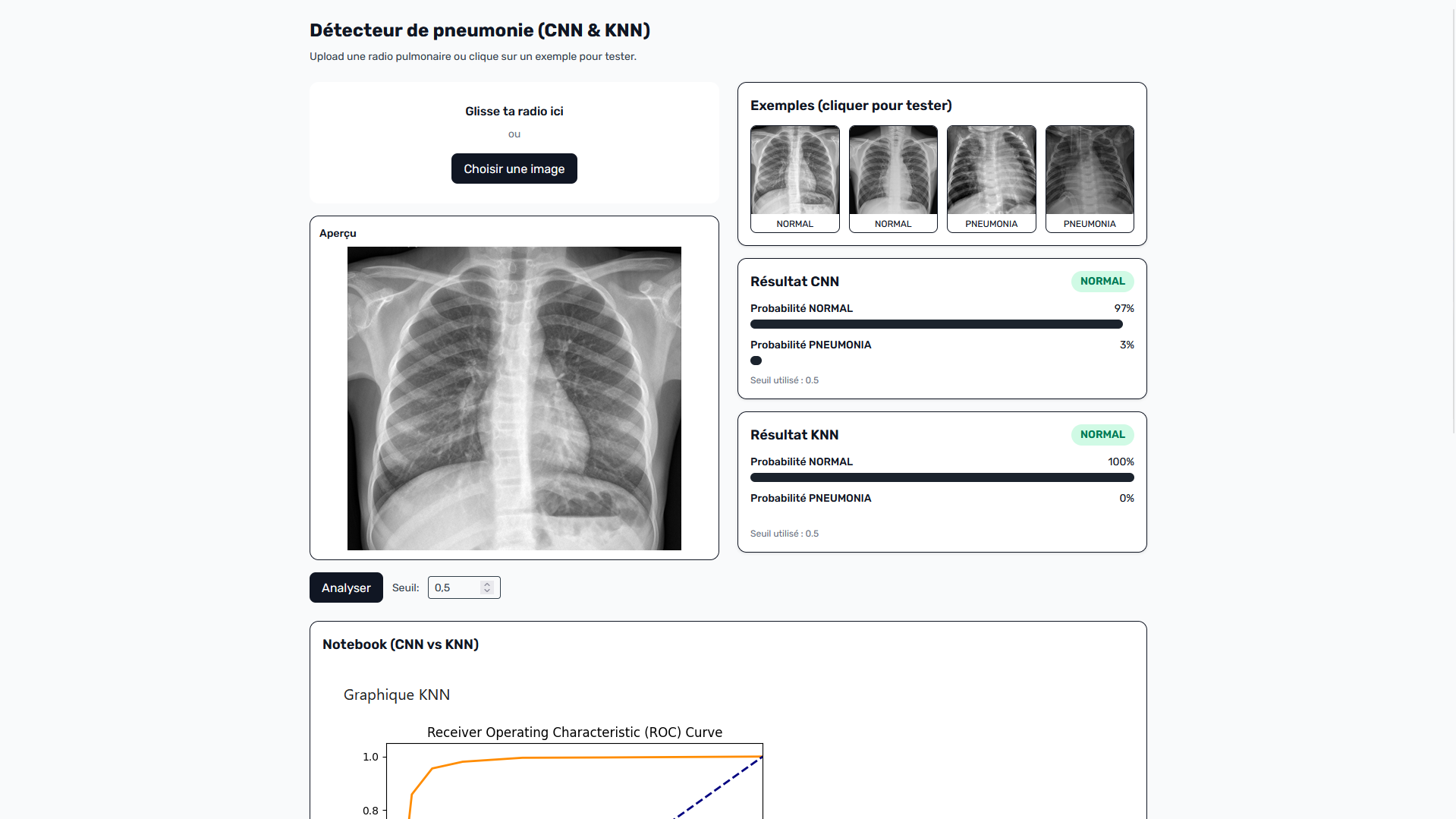
A web interface then allows testing the models in real time.
Users can:
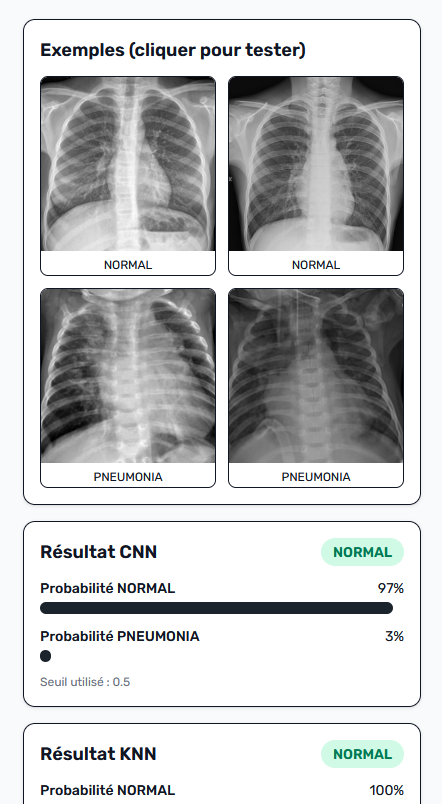
- select sample X-rays
- upload their own images
- get an instant prediction (NORMAL or PNEUMONIA)
- view the probabilities associated with each class.
Key features
- AI analysis of chest X-rays
- comparison of two machine learning approaches (CNN vs KNN)
- interactive web interface to test the models
- custom image upload for analysis
- display of classification probabilities
- visualisation of performance metrics.
Results
Both models were evaluated on an independent test set.
The CNN model achieves the best performance with:
- accuracy of around 95%
- an ROC curve with AUC close to 0.99
The KNN model reaches an accuracy of around 93%, showing that a simpler approach can already produce correct results, but remains less effective than a convolutional neural network for medical image analysis.
These results confirm the effectiveness of deep learning models for chest X-ray image classification.

:quality(75))


:quality(75))

:quality(75))